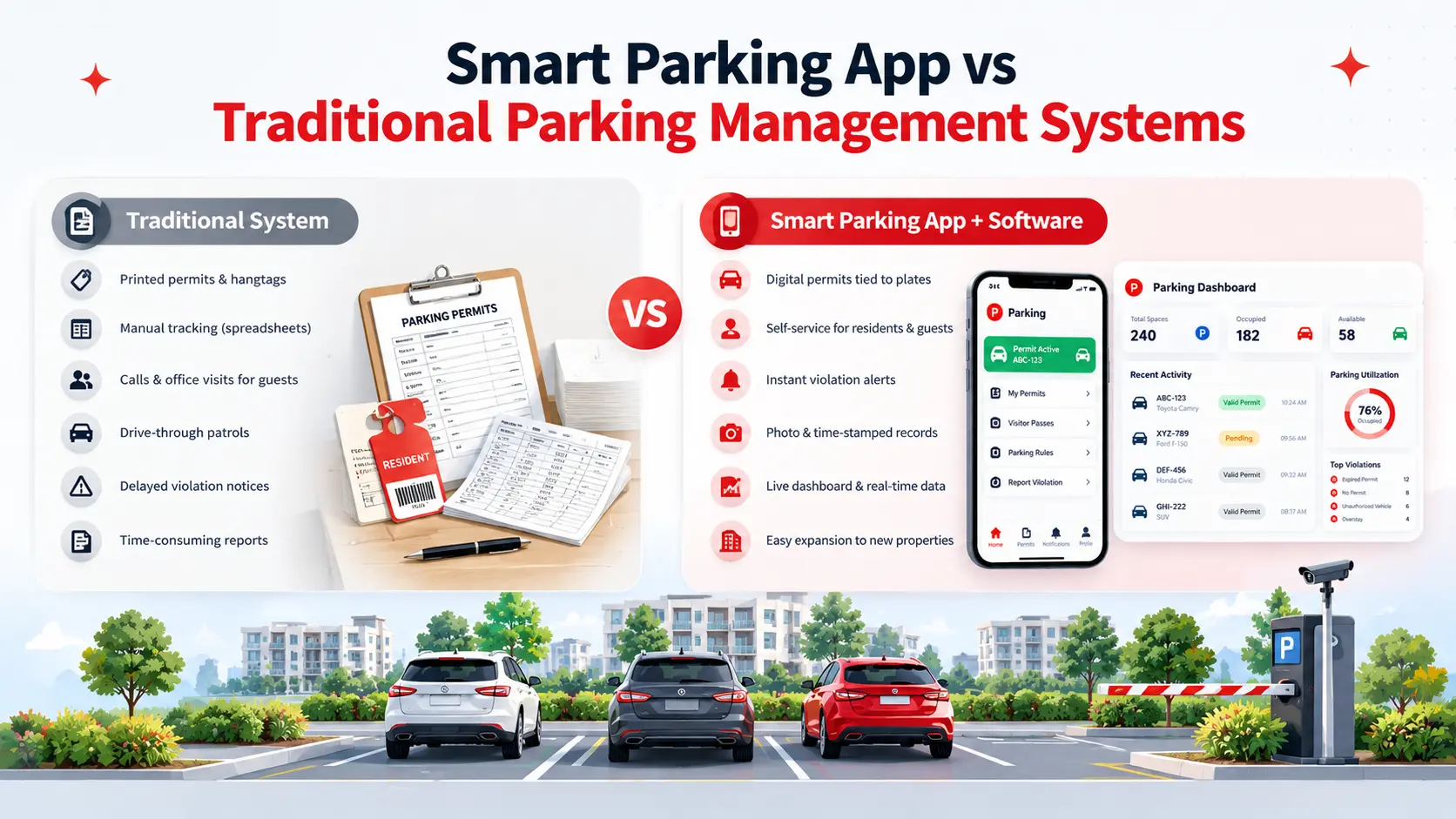
Most property managers didn’t pick their parking system. They inherited it. Maybe it’s a binder left by the last manager, a box of hangtags in the leasing office, or a spreadsheet nobody fully trusts.
It works, mostly. Then a resident complains, or a tow goes wrong, and you start wondering if there’s a better way.
There is. It’s called a smart parking app. In this guide, I’ll explain how it compares to the traditional setup, where each one works, and which one makes sense for your property.
What “traditional” parking management means
It just means parking that runs on people and paper.
You print permits and hangtags. You keep plate numbers in a spreadsheet. Guests sign a log at the front desk. Someone, whether staff or a towing company, drives around the lot looking for problems.
Some properties also have gates, ticket machines, or card readers. Those help control who comes in. But the rules, permits, and records still sit in different places.
What a smart parking app is
A smart parking app is the part your residents and guests use. They open it to register a car, request a permit, add a visitor, or pay a fee.
Behind the app is smart parking software. That’s the part you use. It stores your rules, checks cars against them, flags violations, and keeps records. Some companies call it parking operations software, because it handles the daily work of running a parking program: permits, enforcement, payments, and reports.
You need both. An app without the software is just a form. Software without an app sends all the work back to your team.
Digital permits tie them together. Instead of a hangtag, the permit is a record linked to a license plate.
Side by side
| Traditional system | Smart parking app + software | |
| Permits | Printed hangtags and stickers | Digital permits tied to plates |
| Guest parking | Call or visit the office | Guests registered online |
| Resident requests | Handled by your team | Residents do it themselves |
| Finding violations | Patrols and complaints | The system flags them |
| Tow records | Notes and phone photos | Photos, time stamps, permit status |
| Visibility | A spreadsheet, if it’s current | A live dashboard |
| Reports | Built by hand | Built in |
| Adding properties | Start over each time | Reuse your rules and setup |
Where traditional systems struggle
You probably know most of these already.
Hangtags get copied, loaned out, or left in a moving truck. The spreadsheet is out of date the day someone buys a new car. You hear about violations when someone complains, not when they happen. And if a tow gets disputed, you’re trying to piece it together from memory.
The bigger issue is that every task needs a person. That’s fine with fifty units. With five hundred, it takes over your week.
Where a smart parking app does better
Permits that can’t be passed around. A digital permit is tied to a plate, so a copied tag is useless. TowCentric says its Digital Permits system can cut manual permit work by up to 90%.
Fewer requests for your team. Residents add cars and guests from their phones, any time of day.
Faster enforcement. You set the rules once. The software flags a problem when it happens, and the case can go straight to your enforcement partner.
A record for every tow. Photos, a time stamp, and the permit status make it easy to show what happened.
Data you can use. One dashboard shows active permits, open violations, and activity across your properties. You can spot patterns instead of guessing.
When traditional still makes sense
A smart parking app isn’t right for every property.
If you’ve got a small building, maybe a dozen spaces, hardly any guests, and no towing contract, a simple permit list may be enough. The setup work might not be worth it.
The picture changes as you grow. If you manage several communities, deal with regular disputes, or spend hours each week on permits, the manual way is probably already costing you more than software would.
How to compare cost
Vendors price things differently, so one flat number can be misleading. Look at the whole picture.
For your current setup, add up printing, staff hours spent on permits and complaints, replacement tags, and time lost on disputes. For smart parking software, ask for a quote based on your property size, hardware, and support. Then compare the two by hours saved, not only dollars spent.
How to switch without the chaos
Start with one property. That way you can learn what works before you roll it out everywhere.
Write your rules in plain language first: zones, time limits, how many permits per unit, and your guest policy. Then tell your residents ahead of time. A short notice explaining what’s changing and how to sign up goes a long way.
Expect a little pushback. Some residents will like the old way, and you’ll get questions in the first few weeks. Make it easy for people to ask for help, and it settles down quickly.
Questions to ask before you pick a system
- Is the app easy for residents who aren’t great with technology?
- Can I set rules and zones without a developer?
- Does it save photos and time records for every violation?
- Is detection connected to enforcement, or do I enter things twice?
- Are reports live?
- Does the price go up with every user I add?
- Who picks up the phone when something goes wrong at night?
See it on your own properties
TowCentric is an all-in-one cloud platform for towing and property parking. Digital permits, smart parking, enforcement, and dispatch all run from one login. More than 200 customers use it across 15,000+ properties. Over 7 million digital permits have been issued, and our parking programs serve more than 120,000 residents across the U.S.
Want to see how it would work on your properties? Book a free 20-minute walkthrough. No pressure, no commitment.
Book a Free Demo | Explore TowCentric Smart Parking | See the Property Portal
FAQs
What is a smart parking app?
It’s the part of a smart parking system that residents and drivers use. They can register a car, request a permit, add a guest, or pay a fee.
What’s the difference between a smart parking app and smart parking software?
The app is what residents use. The software is what you use to set rules, check cars, flag violations, and keep records.
What is traditional parking management?
It’s parking run with paper permits, spreadsheets, guest logs, and manual patrols. Some properties add older gate or ticket machines.
What are digital permits?
They’re permits stored as records linked to a license plate. There’s no hangtag to copy, lose, or share.
What is parking operations software?
It’s software that handles the daily work of a parking program, including permits, enforcement, payments, and reports.
Is a smart parking app better than traditional parking management?
For most apartment and HOA properties, yes. It cuts manual work and creates records. A very small property with few parking issues may not need it.
Do residents have to download an app?
It depends on the platform. Some use an app and some use a web portal. Ask the vendor what your residents will actually need.
Can smart parking help with towing disputes?
Yes. Photos, time stamps, and permit records give you proof for each tow.
How much does a smart parking system cost?
It depends on property size, hardware, and support. Most vendors give a custom quote, so ask for one based on your properties.
How long does it take to switch?
It depends on the property. Most people start with one site and expand once the rules and permits are set up.